


Delhi to Gurugram in 10 Minutes: What the Proposed Tunnel Means for Real Estate
If you have ever sat in the standstill between Dhaula Kuan and Cyber City at 9 in the morning, you understand why this news matters.
The 28-30 km Delhi-Gurugram corridor is one of India's most economically productive commute routes and one of its most punishing. Peak-hour travel times regularly touch 60 to 90 minutes, costing commuters, businesses, and the broader NCR economy hundreds of crores in lost productivity every single year.
Now, the Central Government is considering a solution that comes from underneath the problem entirely.
Union Minister Nitin Gadkari has confirmed that the Ministry of Road Transport and Highways has appointed a consultant to carry out a detailed feasibility study for a high-speed tunnel connecting Talkatora Stadium in New Delhi to Gurugram. If approved and constructed, the tunnel could reduce that daily ordeal to just 10-15 minutes.
For real estate investors, homebuyers, and developers, this announcement is not just an infrastructure story. It is a value-creation signal - and history across the NCR is consistent: those who act before the groundbreaking ceremony consistently capture the highest returns.
What the Government Is Actually Proposing
The tunnel is not an isolated concept. It is part of a structured programme of road infrastructure investment that Gadkari has been advancing for the National Capital Region.
In an interview with Mint, the minister stated: "We are planning to build a tunnel, and research and a study are underway... from Talkatora Stadium to Gurugram. At present, the project is in the research phase. A consultant has been appointed."
The project emerged from a high-level meeting chaired by Gadkari on June 4th, attended by Delhi Lieutenant Governor V.K. Saxena and Chief Minister Rekha Gupta. Two specific underground or elevated links were discussed and minuted with directives for action:
Link 1 - Sarai Kale Khan to INA-Nelson Mandela Marg: Either a tunnel or an elevated stretch to be incorporated into the existing tender process for the INA-Mahipalpur elevated corridor.
Link 2 - Gyarah Murti / Talkatora Stadium to INA-Mahipalpur via Nelson Mandela Road, Vasant Kunj: This is the primary tunnel route being studied, with the Gurugram entry point as the end destination.
The funding intent is serious. The Transport Ministry has earmarked Rs. 30,000-40,000 crore specifically for Delhi infrastructure projects, part of a total Rs. 1 lakh crore commitment to decongesting the capital's road network. This is not a budget line that gets announced without political backing at the highest level.
Current status: The project is in the feasibility and research phase. NHAI has been directed to conduct the study. No groundbreaking or construction timeline has been announced.
To understand what infrastructure allocation at this scale historically means for property markets, our analysis of the Union Budget 2026 and the shift to infrastructure-driven real estate investment provides useful context.
Why Commute Time Matters More Than Distance in Real Estate
Delhi's road pressure is not an abstract problem. Data from Vahan, the Centre's vehicle registry, shows that during 2024-25 alone, over 4.5 lakh two-wheelers, 1.9 lakh cars, 2,300 buses, and approximately 17,200 trucks were newly registered in the capital. The infrastructure is being asked to absorb a fleet that grows by lakhs every year.
But for property investors and buyers, the more important insight is this: real estate markets do not price physical distance. They price commute time.
A 30 km drive that takes 75 minutes and a 30 km tunnel journey that takes 12 minutes are valued entirely differently by buyers, tenants, and corporates. When commute time collapses, the psychological map of the city redraws itself. Areas that previously felt peripheral begin to feel central. That perceptual shift is what drives property price appreciation along infrastructure corridors.
This is the core thesis behind infrastructure-linked real estate investment, and it plays out every time a major connectivity project is completed in the NCR. The question worth examining carefully is: which pockets stand to benefit most when the Delhi-Gurugram travel time drops from an hour to fifteen minutes?
We explored the underlying investment logic in detail in our piece on location vs. timing in real estate investment - and infrastructure events like this tunnel are precisely the moments when both factors align in an investor's favour simultaneously.
The Real Estate Impact: Four Zones to Watch
Every major connectivity upgrade in the NCR has followed a consistent pattern: speculative interest moves first, followed by a sustainable price revision once the project breaks ground, and then a second wave of appreciation at commissioning. The Delhi Metro, the Dwarka Expressway, and the KMP Corridor all followed this script. The tunnel will follow the same curve - potentially faster, given the scale of capital being deployed.
Here is how we at Realty Applications map the impact zones:
Zone 1 - Southern Delhi and the Vasant Kunj-Mahipalpur Fringe
The neighbourhoods immediately adjacent to the Delhi-side tunnel entry point are the most direct beneficiaries of this project. Areas around Nelson Mandela Marg, Vasant Kunj, and Mahipalpur already sit at one of the most airport-proximate locations in the capital. Adding a fast underground link to Gurugram would make them arguably the single most connected residential and commercial nodes in the entire NCR - equidistant in time from the airport, central Delhi, and Gurugram's commercial districts.
Commercial and mixed-use assets in this pocket have historically been under-valued relative to their location. That calculus is likely to change if the tunnel route is confirmed.
Zone 2 - The Dwarka Expressway Corridor
The Dwarka Expressway corridor has already delivered substantial returns to early investors, with property values along certain stretches appreciating 40-60% since the expressway became fully operational. The proposed tunnel's Gurugram terminus sits broadly in the same western corridor of the city, and any incremental enhancement to Delhi-Gurugram connectivity directly amplifies the momentum this belt has already built.
Projects in Sector 104, Sector 103, and Sector 106 sit at the intersection of existing expressway infrastructure and the proposed tunnel corridor - a positioning that is difficult to replicate.
Zone 3 - New Gurugram: Sectors 58-80 and the Golf Course Extension
The perennial friction point for New Gurugram has always been the "far from Delhi" objection. For buyers comparing a DLF Cyber City-adjacent address against a Sector 65 or Sector 67 address, the commute differential has always tilted the decision toward the older, more centrally located parts of Gurugram.
A 10-minute tunnel dissolves that objection entirely. Sectors currently perceived as peripheral to the Delhi-Gurugram axis - including Sector 65, Sector 67, and the Golf Course Extension belt - would become highly accessible to Delhi-based professionals who have historically ruled them out on commute grounds alone.
For a detailed view of which specific micro-markets in this zone present the strongest opportunity, our guide to the best areas to buy property in Gurugram in 2026 is worth reading alongside this analysis.
Zone 4 - The Ultra-Luxury Segment
At the top of the market, the ultra-luxury residential segment in Gurugram — anchored by DLF, M3M, Whiteland, Sobha, and Central Park - has been on a structural bull run driven by strong corporate demand and limited supply of truly premium product.
High-net-worth buyers who balance their week between Delhi meetings and Gurugram living will find the investment case for Gurugram residential real estate significantly strengthened by the tunnel. The commute friction that occasionally drives these buyers toward Delhi's Lutyens and South Delhi markets would be largely eliminated.
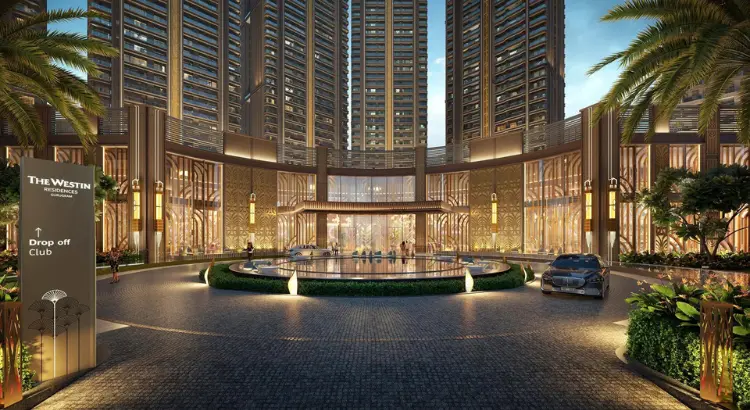
Developments like Sobha City in Sector 108 and Whiteland Westin Residences in Sector 103 are already attracting exactly this buyer profile. The tunnel confirmation would add another layer of justification to the premium pricing these projects command.
What the Dwarka Expressway Story Teaches Us
The most instructive parallel for this tunnel is the Dwarka Expressway - a project that was proposed, delayed, litigated, and eventually delivered over a 15-year arc.
Investors who bought in Sectors 102-113 during the early years of scepticism and construction delay - when the project was mocked for its slow progress - captured appreciation of 3-5x by the time the expressway became fully operational. The patience required was significant. The returns were commensurate.
We are currently at the earliest stage of the Delhi-Gurugram tunnel's lifecycle: the feasibility phase. This is, historically, the window that offers the highest potential upside and the lowest competition from informed capital. It also carries the highest uncertainty, and any serious investor must price that in honestly.
The India real estate growth outlook from 2026 to 2031 already identifies infrastructure-linked corridors as the priority thesis for sophisticated investors. This tunnel fits squarely into that framework, and the top real estate investment trends for 2026-27 point in the same direction.
The Key Milestones Investors Should Monitor
Do not make investment decisions on the announcement alone. Infrastructure projects in India are delivered through specific, verifiable milestones. These are the events we are tracking:
Next 3-6 months - NHAI Feasibility Report: The preliminary report will confirm or revise the proposed route, provide initial cost estimates, and establish the engineering viability of the tunnel. This is the first major de-risking event. A positive report will trigger the first wave of market interest.
6-18 months - Tender Incorporation: The Gadkari meeting directed that the tunnel links be incorporated into the tender process for the INA-Mahipalpur elevated corridor, which is already underway. How the tunnel is written into that contract will clarify scope, funding structure, and execution intent.
18-36 months - DPR Approval and Funding Announcement: The Detailed Project Report and its acceptance by the relevant ministries is historically the milestone at which property prices along the corridor record their sharpest single appreciation. This is the institutional confirmation that the project will be built.
5-8 years - Construction and Commissioning: Comparable underground infrastructure projects in Indian metros have taken between 5 and 8 years from DPR to operations. Investors entering now should plan for a medium-to-long holding period and underwrite their returns accordingly.
How to Position Your Portfolio
A few practical principles for investors assessing this opportunity:
Think time-distance, not physical distance. The entire value shift driven by this tunnel is about commute time compression. Properties that benefit from reduced psychological and actual travel distance to Delhi will appreciate, even if they are not directly above the tunnel route.
The pre-announcement window is where the real returns are made. Once the DPR is approved and construction begins, prices along the corridor will have already moved significantly. The current feasibility phase is where patient capital earns its premium.
Residential and commercial both stand to gain. Reduced commute times historically catalyse office and retail absorption alongside residential demand. Gurugram's commercial belt - already among India's most productive - will become even more attractive to corporates with Delhi-heavy employee bases.
Understand your holding horizon. This is a medium-term thesis, not a quick trade. Investors who plan for a 5-7 year hold from today will be best positioned to capture the full arc of value appreciation - from feasibility confirmation through to commissioning.
For property-specific guidance on where to look within the impact corridor, our real estate investment advisory service can help you map the opportunity to your specific budget and risk profile.
Properties to Explore in the Impact Zone
If this analysis has prompted you to look more seriously at the corridor, our curated project listings across key Gurugram sectors are a useful starting point:
- Projects in Sector 104, Gurugram - Dwarka Expressway
- Projects in Sector 103, Gurugram
- Projects in Sector 106, Gurugram
- Projects in Sector 112, Gurugram
- Projects in Sector 109, Gurugram
- Browse all Gurugram projects
The Bottom Line
The Delhi-Gurugram tunnel carries meaningful uncertainty. It may be re-routed, delayed, or modified significantly by the time a Detailed Project Report is finalised. That is the honest position, and any adviser who tells you otherwise is overselling.
What is not uncertain: the intent is real, the political will is present at the highest levels of the government, and the financial commitment - Rs. 1 lakh crore for Delhi decongestion is substantial. This is not a speculative press release. It emerged from a formally minuted meeting that included the Delhi LG, the Chief Minister, and a directive to incorporate the links into an active tender process.
For Gurugram's real estate market - which has already demonstrated exceptional demand depth and pricing resilience in recent years - the tunnel adds another structural tailwind to a story that was already compelling. As it has always been in real estate, the best time to evaluate an opportunity is before the crowd arrives.
We will continue tracking the tunnel's progress across every edition of The Realty Insider. If you would like to discuss how this infrastructure development should influence your specific investment approach, our advisory team is available for a one-on-one consultation.
Related Reading:
- Best Areas to Buy Property in Gurugram in 2026
- Dwarka Expressway Property Price Trends 2026
- India Real Estate Growth 2026-2031: CAGR and Investment Guide
- Top Real Estate Investment Trends in India for 2026-27
- Delhi-Mumbai Expressway: Route, Map and Real Estate Impact
- KMP Expressway: Routes, Toll Charges and Investment Guide
- Disneyland Manesar: Location, Announcement and Real Estate Impact